
Dispersion models
Biodiversity is often reported to be sensitive to climate change and the water temperature is considered to be an important factor for range shifts in most marine environments leading to changes in ecosystem services. In brackish or low saline waters such as the Baltic sea, Kattegat and Skagerrak the salinity is another important factor. In conjunction with temperature and salinity, changing ice conditions also affects both native and non-native species. This can happen either in a way so that both species thrive or in a way that is positive for one but negative for the other. Either way, this change alters the balance between the different populations.
Climate ocean models show that the general trend in the Baltic sea (until the end of the century for emission scenarios RCP4.5 and RCP8.5) is increasing sea surface temperatures and decreasing sea surface salinities. The cyclonic circulation in Skagerrak is enhanced, affecting both dispersal and salinity, see Figure 2.1. It should, however, be noted that while the climate signal for the temperature increase is rather strong, the signal for salinity is more uncertain especially in the Baltic Proper. Furthermore, it has been shown that the cyclonic circulation is enhanced in the Skagerrak. This causes more freshwater from the Balitc sea to be recirculated which freshens the southern part of the Skagerrak. The circulation pattern also affects the dispersal of larvae and may increase the pressure of invasive species along the Swedish coast of Skagerrak. Ice extent and thickness are decreasing in Skagerrak, Kattegatt and the Baltic sea.
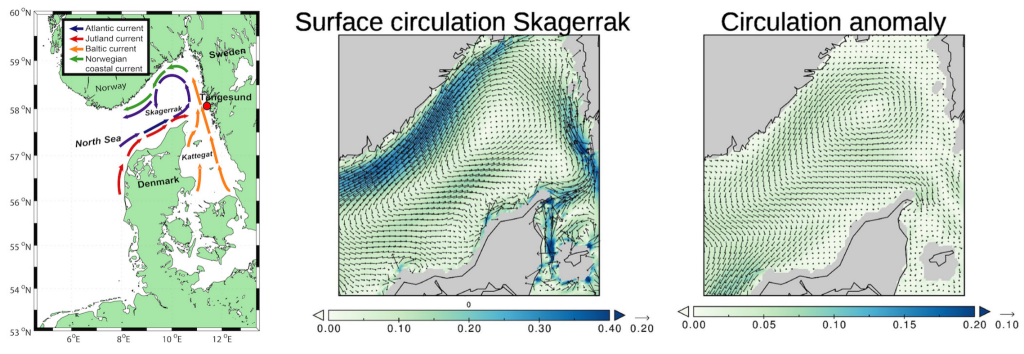
Figure 2.1. General currents to the left (Fig. 1, Karlsson, 2006). Two circulation plots of ensemble means
for the Skagerrak to the right (Fig. 5, Gröger et al. 2019), where the color bars indicate current speeds
[m/s]. Middle: average summer circulation (1970–1999). Right: difference (2070–2099 minus 1970–1999).
Note the different scaling of the color bar and the different scale of the reference vector.
It is, however, not only climatology anomalies or changes in seasonal averages that are interesting but also extreme weather events such as shorter marine heat waves and ice winters etc. It has, for instance, been shown using the concept of accumulated degree days, where total degree days are given by:
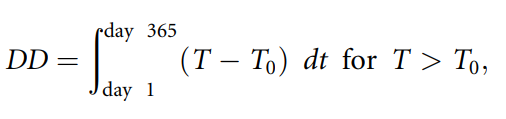
that climate change for example accelerates the range expansion of the non-native species Pacific oysters, Magallana gigas . Here T is the ambient temperature that the species is exposed to, and T0 is a threshold temperature below which no development/growth occurs. T and T0 are given in degree Celsius.
Furthermore, severe ice conditions during ice winters can substantially influence non-native species that aren’t adapted to such conditions, but research on the interactions between the invasive pacific oyster and native mussels indicate that in practice oysters often have the upper hand .
The Swedish Agency for Marine and Water Management, SwAM, states that routes of invasion of invasive species can be difficult to predict, but at the same time it is not possible to monitor everything everywhere. There is therefore a need for methods based on the most likely routes of transmission of invasive species, so that a wise selection of inventory sites and methods can maximize the possibility of invasive species to be detected in time. Here dispersal and connectivity studies will be used.