
Ecosystem impacts
Invasive species, by definition, influence biodiversity and other important ecosystem functions. These effects can be difficult to value, but invasive species may also have direct economic significance. As an example of an invasive species that the project will study, the pacific oyster (and its “companions”) is an illustrative case showing the many ways an invasive species can affect the ecosystem of a recipient area with negative consequences for biodiversity, economy, and overall ecosystem functioning. One of the newly arrived invasive species in the danish Limfjord are the Asian Pacific oyster (Magallana gigas), which has spread to large parts of the fjord, where it occurs in large densities. Pacific oysters have so far been found primarily in the shallow water close to the beach zone, where, unlike the native flat oyster (Ostrea edulis), each specimen preferable attaches conspecifics, and, over time will form contiguous “oyster reefs”. This ability makes the Pacific oyster a so-called ecosystem engineer, which means that the species can create and maintain a new habitat by changing or destroying the original. The pacific oyster can even turn soft bottom areas into hard-bottomed reefs.
However, the greatest threat to the local fauna may be of a more indirect nature. Pacific oysters rarely arrive alone! They often carry diseases such as e.g., the parasite Bonamia ostreae, which does not seriously affect the invasive pacific oyster, but is deadly to the native flat oyster. The introduction of this parasite has thus been the direct cause to a drastic decline in the populations of flat oysters throughout Europe and the oyster is now considered as a threatened species. Also, the predatory snail Asian oyster drill, Ocinebrellus inornatus, has been accompanying the arrival of the Pacific oyster. The Japanese oyster drill (Ocinebrellus inornatus), introduced to the Limfjord, Denmark. The Asian oyster drill is an effective predator that has Pacific oysters as its main prey, but likes and in some cases prefers other mussels, including flat oysters and the economically important blue mussels, Mytilus edulis. The oyster drill has built up large populations in Limfjorden and will probably within a not too far future be able to fundamentally change the composition of the benthic fauna in the Limfjord as it has happened in other places where it has been introduced.
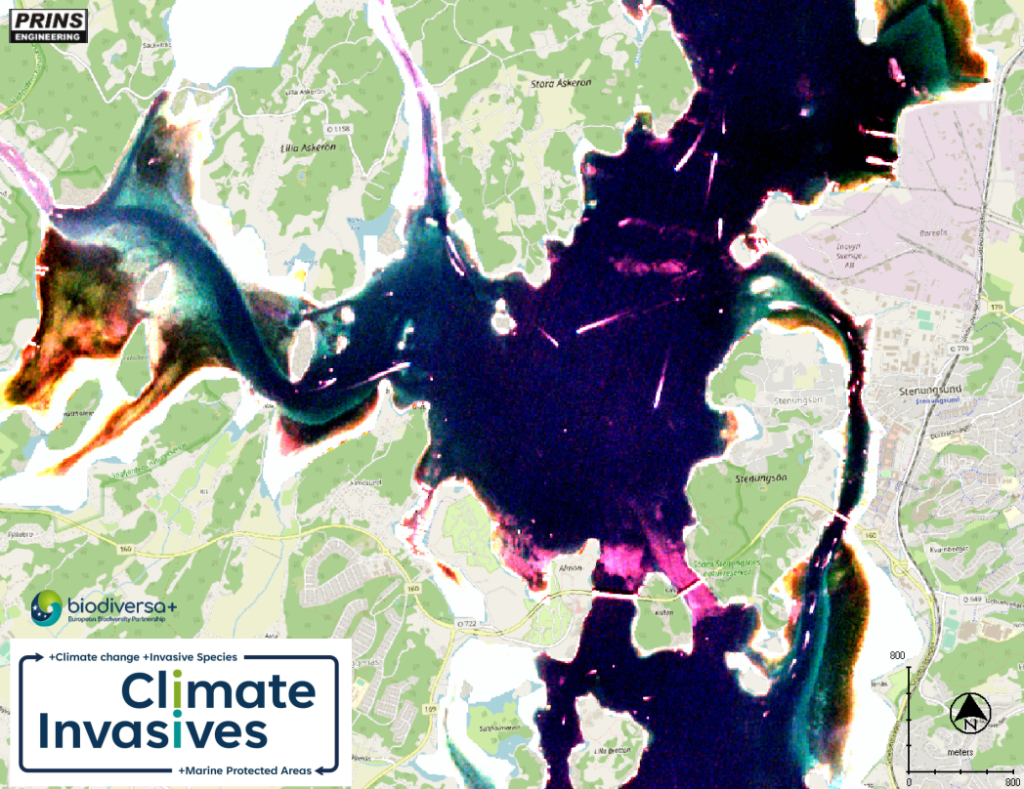
We will employ Earth Observation techniques to enhance our understanding of habitats and refine our predictive modelling of the spread of invasive species. The Tjorn-Orust area, near the Swedish city of Stenungsund, is a focal point of our research due to its extensive Eelgrass (Zostera marina) regions. These areas are environmentally significant and serve as habitats for the invasive clinging jellyfish (Gonionemus vertens). We have conducted field visits during the summer 2023 to gather in-situ information on the benthic conditions. This involved utilizing a variety of sampling techniques, including transect diving. The data collected will be used to calibrate satellite imagery and subsequently classify the spatial data into distinct habitat types using AI technology. This value-added data will then be integrated into our predictive models for the spread of invasive species.
In the project we will develop species distribution aiming to provide credible predictions of future dispersal and population density for selected (harmful) future and current invasive marine species. The species distribution will be based on a combination of field observations (physical sampling), eDNA, oceanographic and remote sensing data.