
Detection
It is likely that transmission of alien species is an ongoing process but the mechanisms behind the establishment of a species in a new ecosystem and that this species eventually become invasive and able to spread beyond the initial landing site is more complex . One model for this process is that alien species are introduced in environments that are particularly suited for an initial settlement (so called “invasion hubs”) and that the species spread from there at a later stage when surrounding physical factors allow dispersal. These hubs are often suggested to be the actual point of entry such as marinas or ports, but in this project we will also investigate enclosed sea bodies with particularly suitable environments (e.g. nutrient rich and warm) for the establishment of an invasive species not necessarily introduced directly there. One such example is the polychaete tubeworm Ficopomatus enigmaticus, native to the Southern Coast of Australia, that was first recorded in Copenhagen in 1953 but has only recently spread widely in the southern Baltic Sea most likely thanks to climate change.
In the management area (Figure 0.1) we have identified an enclosed sea body (Limfjorden, Denmark), one major port (Göta Älv estuary, Sweden) and one marina (Sandefjord, Norway) that will act as our study areas and examples for the proposed management approach. For example has Limfjorden proven to be the first place for which several invasive species have been identified, such as the japanese wireweed, Sargassum muticum, the slipper limpet, Crepidula fornicata, the false angelwing, Petricolaria pholadiformis, the Atlantic jackknife clam, Ensis leei, the japanese øyster drill, Ocinebrellus inornatus, the folded sea squirt, Styella clava. The mentioned species occur in the Limfjord in large well-established populations and it must be assumed that their larvae, by virtue of their sheer numbers, can establish new populations in neighboring areas. The Limfjord’s role as a “contagious” source of marine species to neighboring marine areas qualifies the fjord as an invasive hub. The hubs are thus at any given time likely to be home to more invasive species than what is established in the ecosystems surrounding the hubs. It is also possible that the hub acts as not only a repository for potential invasive species but also as a breeding site where the population of the invasive species can grow before it takes the leap to surrounding ecosystems. These “dormant” and potential species are sometimes referred to as ‘door knocking invasives’.
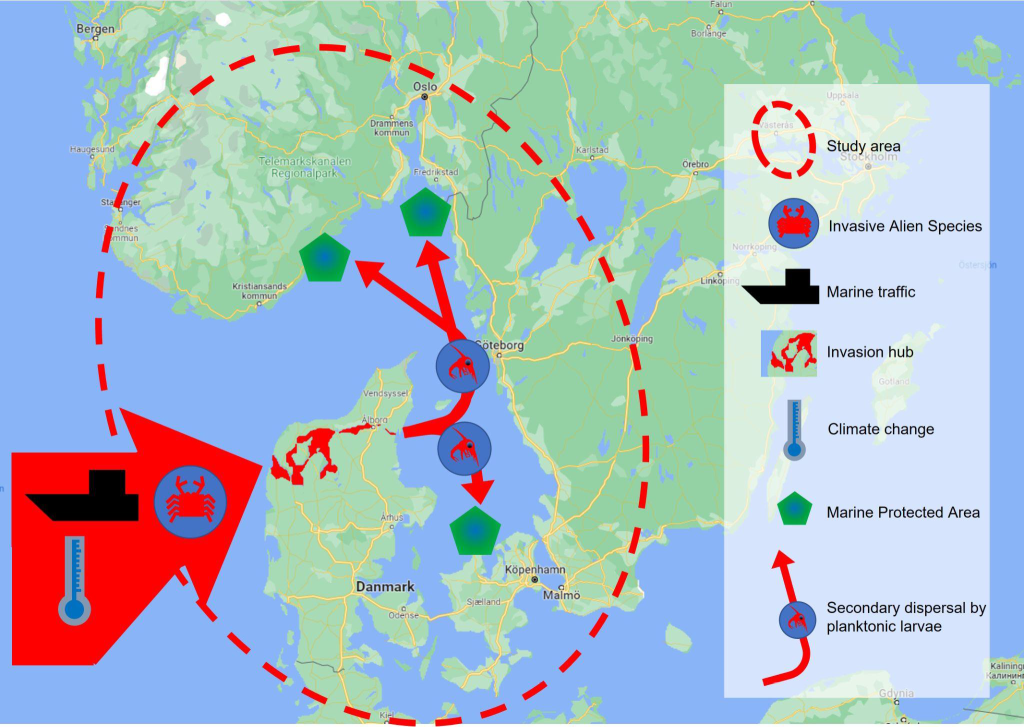
Figure 0.1 Conceptual illustration of the research project. Invasive alien species, IAS, are introduced to new geographical areas via human vectors such as marine traffic. Initially the IAS can be established and survive in particularly favorable areas, which has been proposed to be termed “invasion hubs”. Climate change, which causes a decrease in extreme cold-temperature and icy winters in combination with an increase in above-normal water temperatures, facilitates an increased potential for secondary dispersal of the IAS from the invasion hubs to adjacent areas including Marine Protected Areas, MPAs. Since many marine species have the potential for long-distance larval dispersal across national borders, management strategies for IAS must be developed in collaboration by stakeholders from national authorities, NGOs and the private sector in all the countries in the geographical area within the dispersal-radius of the IAS.
Shipping is considered as the largest vector for transfer of IAS and can greatly facilitate the spread of species both over large geographic areas and across or towards ocean currents. The time larvae from marine organisms can survive in the water mass is limited (days) and with ships as vectors the possibilities of larvae surviving the transfer increase due to the shorter transit time. The conditions in a ballast water tank or other areas on the ship where species can occur are however highly variable in for example temperature and oxygen supply. It is therefore the tolerant species that in addition have characteristics like high reproduction and fast growth rate that are known to both survive the transfer with ships and become established in new environments. The International Maritime Organization (IMO) Ballast Water Management Convention is in force since 2018 and requires that ships treat the Ballast water to certain threshold values before discharge. The threshold-values in BWMC still allows for a certain number of organisms to be released and further are biofouling species and species transferred on other locations on the ships (niche areas) not regulated. Continuous new introductions to the areas is therefore expected and will be calculated based on traffic patterns and AIS-data. As the IMO Biofouling guidelines under review 2021-2022 there is an increased focus on taking measures for the biofouling and niche area species within the project.
Methods for detecting IAS in this project include:
- Sampling for door knocking species in the hubs.
- Metabarcoding analyses of eDNA from water samples in the management area.
- Calculations of the expected ship-mediated transfer of IAS as larvae in ballast water tanks, biofouling organisms and mobile species in niche areas (sea chests and anchor boxes) using data of ship type and size (dry weight tonnage) and traffic (AIS-data).