
Clinging jellyfish
Gonionemus sp.
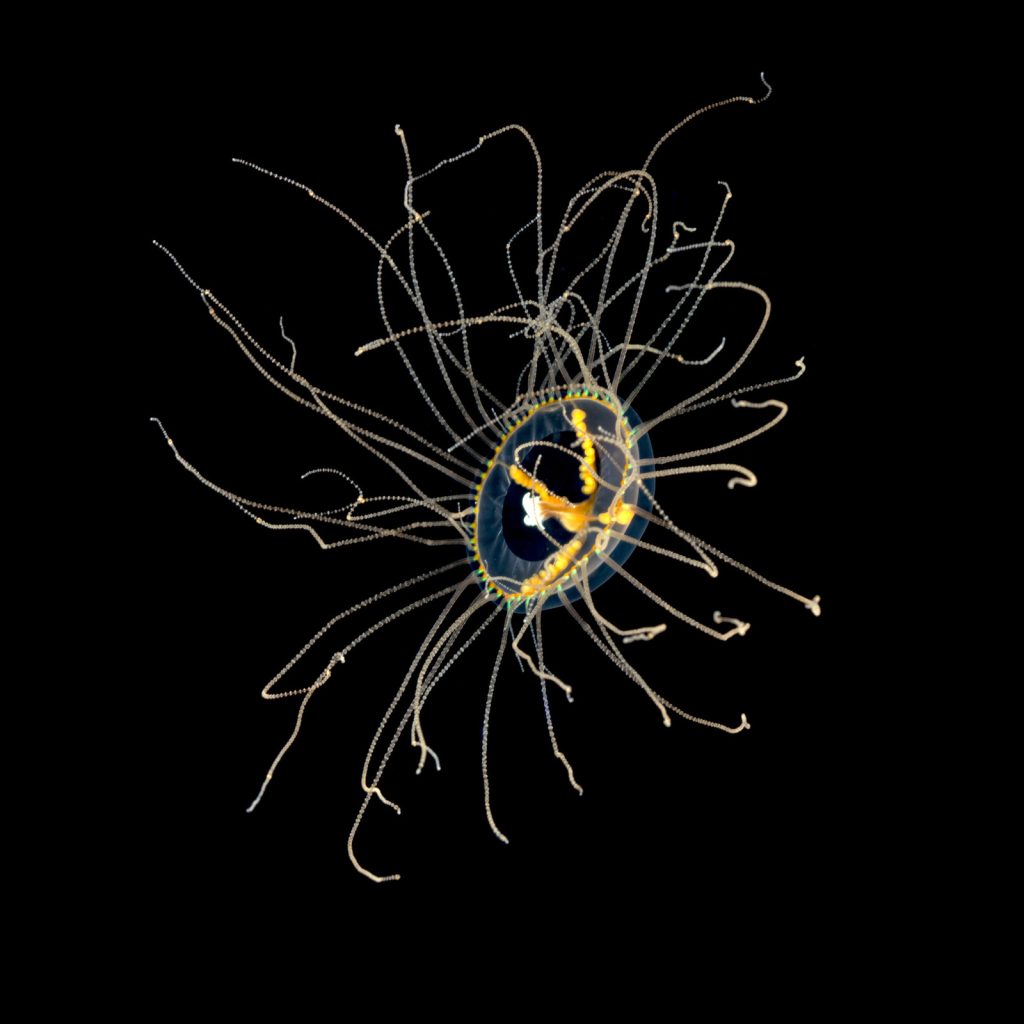
Photo: Matz Berggren/SLU Artdatabanken
The clinging jellyfish (Gonionemus sp.) is a hydrozoan that develops from a polyp stage to a medusa stage where the diameter of the medusa bell can be up to 25 mm. The first finds of the jellyfish in Sweden were reported in 1923 in the Gullmar fjord. In 2018, it was reported as locally numerous at a few locations in eelgrass beds in sheltered bays inside Orust and Tjörn on the Swedish west coast. The species does not yet appear to be spreading outside these bays. The clinging jellyfish occurs naturally in the North Pacific but has spread to the US, the Atlantic coast of Europe and the Mediterranean Sea.
The species can be introduced to new areas via ship traffic, either as eggs or in the medusa stage via ballast water or by attaching to the hull of the ship during the polyp stage. One theory is that polyps may have arrived in Europe attached to imported oysters.
The tentacles of the stinging jellyfish burn and can cause skin irritations and severe allergic reactions in humans.
When they are in the medusa stage, they are usually found in calm bays with eelgrass beds. During the day, they cling to the eelgrass using suction plates on their tentacles. They can also be free-swimming, but this mainly occurs at nighttime.